
Virtual First 2025: Designing a culture that drives impact

2026 marks five years since we committed to Virtual First, our operating model where remote work is the primary experience for employees, and we prioritize in-person connection through regular gatherings. In that time, we’ve moved beyond the “what ifs” to a much clearer understanding of what’s working, what isn’t, and what needs to change. What hasn’t wavered is our core belief that Virtual First is a flexible model that allows us to continue learning and adapting, while shaping how we design products for a distributed world.
As we launch into 2026, we’re taking a close look at what we’ve learned over the past year to better understand how our culture drives employee satisfaction, which ultimately fuels our productivity and impact. Together, they form the foundation of how we build, operate, and evolve in a Virtual First world.
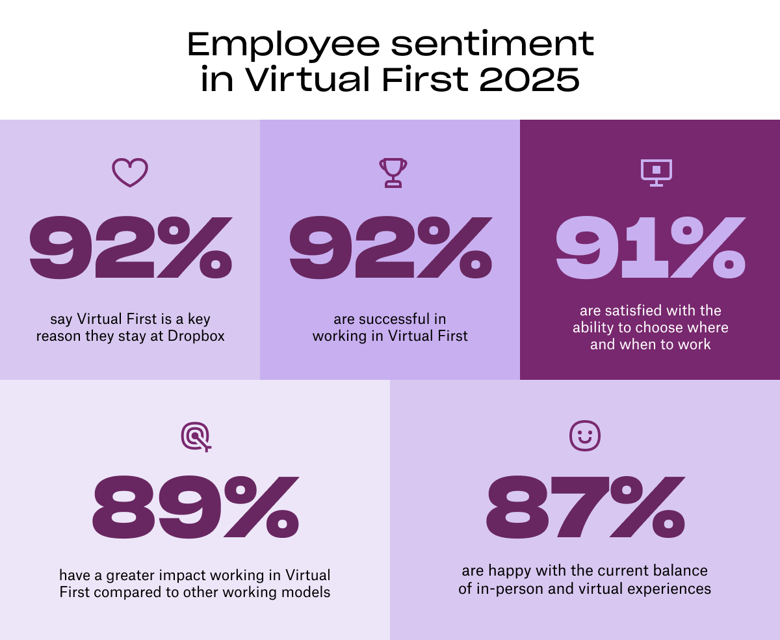
Survey says: Virtual First remains strong, stable, and strategic
While the return-to-office debate rages on, we’ve stayed focused on why Virtual First works for us. And our evidence is clear: Not only does Virtual First deliver a powerful way to engage and retain our great talent, it also empowers teams to build products with greater empathy for our customers.
Here’s a snapshot of our standout wins for 2025:
Developer productivity shows clear gains. Developers offer a great lens for understanding knowledge worker productivity because their work produces clear, measurable signals—like code changes and delivery speed—while still relying on the same focus and collaboration dynamics as others. We are exceeding industry benchmarks in almost every category of developer productivity. Our developer experience survey scores jumped eight points compared to 2024 including clear gains in documentation, deep work, and coding environment. Developers are submitting nearly 35% more pull requests (proposed code changes reviewed by teammates). The time it takes to push new code to production has dropped by 40%, bringing us within the 75th percentile of industry benchmarks. The flexibility of Virtual First helps developers find focus and flow, translating directly into faster iteration and greater output.
Virtual First helps us hire the best. In 2025, the number of applications received per role was nearly seven times higher than before Virtual First. Since adopting this model, we’ve seen the lowest attrition rate in company history. Our hiring footprint has also expanded significantly, with 60% of employees based outside large tech markets—proof that top talent can come from anywhere. This broader reach helps us match the right people to the right jobs.
AI adoption is driving real productivity. AI tools are now widely available across the industry, but many companies are still figuring out how to turn access into impact. At Dropbox, it’s not the tools themselves that drive results, it’s how we use them. Through hands-on learning programs and tools built directly into our workflows, AI is becoming part of our everyday work. It’s not just that our AI adoption rates are high (96% of Dropbox employees are using AI tools weekly, 100% among developers); it’s the impact AI is having. 87% of employees say they have access to the AI tools they need to be effective, and 80% understand how to use AI to save time at work.
Employee sentiment stays strong. Dropbox employees feel well supported in Virtual First, with nearly all employees reporting increased satisfaction with their remote setups and confidence in their technology. Collaboration scores continue to rise as people grow more comfortable working asynchronously and across time zones. More than two-thirds of meetings are considered effective. And in-person offsites stand out as a powerful complement to Virtual First, cited five times more often than any other factor in strengthening a sense of belonging.
Focusing on the Big Three
Virtual First is the product of intentional work, not chance. We’ve learned a lot along the way, but it’s not perfect and we know there’s more to learn. That’s why we need to spend as much time addressing our challenges as we do celebrating our successes. In 2025, we focused on the three areas that matter most: focus, meetings, and gatherings.
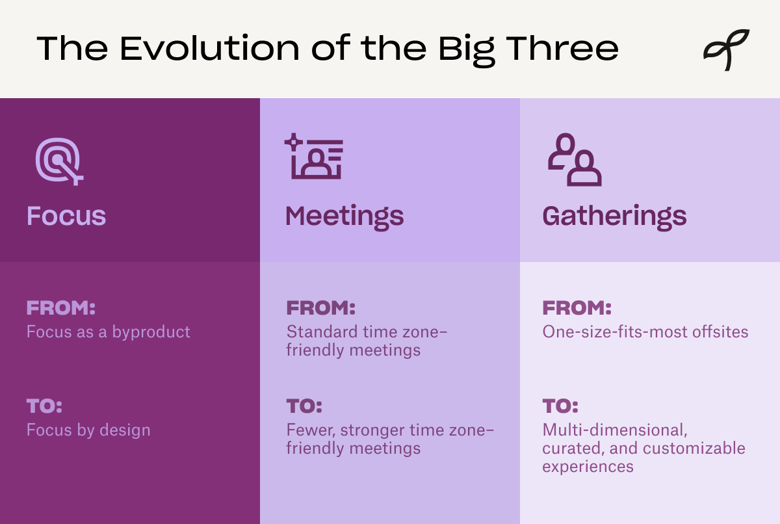

Now, let’s take a look at what 2025 taught us, and how we’re using those lessons to move forward.
What we learned about the Big Three: Focus, meetings, and gatherings
1. Giving people more control helps protect focus time and supports higher performance.
Time is valuable—and limited. Protecting it requires clear expectations, healthy habits, and the right tools.
The industry seems to be drifting toward an “always-on” model. Companies like Microsoft report an increase in late-night work and the “infinite workday.” We’re seeing similar pressures at Dropbox, too. That’s why we’re taking a look at how giving people more control over their time can help everyone work more sustainably and productively.
What we learned:
Our highest-performing employees show that effectiveness isn’t about having fewer commitments, but about structuring work intentionally. While top performers spend about 3.3 more hours per week in meetings and connect with more people across the company, they also protect twice as much uninterrupted focus time and keep meetings shorter. Similarly, what sets our thriving employees apart is how they design their days to balance collaboration, focus, and recovery. They intentionally group meetings together, invest in strong cross-team relationships, and make time to rest and recharge.
The right tools help strong work habits stick. AI and other productivity tools work best when they align with how people do their best work: better focus, less needless back-and-forth, and more time protected for meaningful work. In recent pilots designed to improve focus, we asked Dropbox employees to use Slack’s Do Not Disturb mode during meetings and focus blocks, replace live meetings with Loom videos when real-time discussion wasn’t necessary, and use Reclaim.ai to help them structure their calendars. As you can see, these changes have meaningfully improved the way people worked.
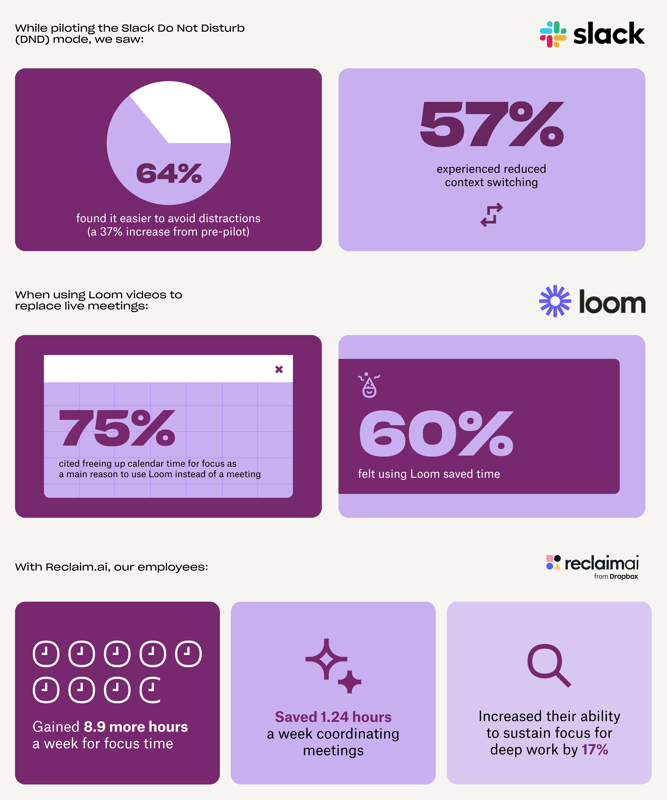
How we’re moving forward:
To build on these insights, we’re creating a Deep Work Index (DWI) to help us understand whether people have—or don’t have—the conditions they need for focused, uninterrupted work. The DWI brings together everything we’ve learned about meetings and autonomy into a single number. It includes metrics such as meeting load, focus time, and how tightly meetings are clustered, which all relate to how able people feel to engage in deep work.
Rather than asking managers to monitor dozens of inputs, the DWI distills work patterns into a single, testable signal related to deep work. While still in it’s early days, the DWI is being explored as a way to identify early signs of meeting creep, interruptions to focus, and calendar fragmentation. It will also assess whether these signals can ultimately inform practical actions like reducing meeting-heavy days, protecting longer focus blocks, or strengthening meeting norms and tools.
2. The goal is meetings that are fewer in number and stronger in purpose.
Yes, we need fewer meetings. But the ones we do have need to be effective. Thoughtful preparation, clear ownership, and support from AI tools make meetings more purposeful and leave more time for deep, focused work.
The number and quality of meetings at Dropbox are in a healthy place compared with external benchmarks. Dropbox employees consider about 70% of meetings effective, versus 28% among knowledge workers overall, and spend less time in meetings than peers at other companies.
Still, meaningful challenges remain. Nearly a third of our meetings are less effective than they could be, with our top challenges being lack of a defined purpose, ownership, or an organized agenda. When those basics are missing, employees report that discussions can drift, feel repetitive, or end without clear next steps. Employees also shared that meeting best practices matter even more in large, cross-functional settings, where friction is more visible.
While it’s encouraging that most meetings at Dropbox are considered effective, the ones that aren’t add up to millions of dollars in lost productivity each quarter. That’s why we’re applying the same operational rigor to our meetings as we do to every other major investment.
What we learned:
Our effort to reduce meetings worked. In 2025, we ran a Meeting Reduction pilot with developer teams that included practices like No Meeting Wednesdays, fewer recurring one-on-ones, and an async-first approach to alignment. The results were clear:
- 27% reduction in weekly meeting hours (1.8 hours)
- 20% fewer meetings per week
- 28% increase in coding time
- 80% of participants found the pilot effective, and 90% recommended scaling the guidance
We need a common way to talk about a meeting’s purpose. Through a design sprint focused on reimagining meetings, we identified a core gap: Teams often don’t have an easily understood way to describe the “why” behind a meeting. As a result, people often join meetings out of obligation rather than purpose, and live meetings remain the default. Giving meetings clear categories—like “decision jams,” “sync updates,” “connection circles,” or “AI briefings”—helps teams understand the goal of a meeting before it begins.
AI-generated meeting summaries save meaningful time. Through our Zoom AI Companion pilot, we found that users saved an average of 37 minutes of work per meeting by using AI-generated summaries and action items. Many found the tool easy to use and especially helpful for asynchronous collaboration, highlighting the growing role AI plays in the Virtual First experience.
How we’re moving forward:
Together, these insights have helped shape our company-wide Meeting Effectiveness initiative—an evidence-based framework that defines best practices by meeting type, stage, and participant role. We’re rolling out improvements in phases, giving teams tools like calendar and agenda reminders, Reclaim.ai scheduling enhancements, plus ongoing support to make sure these habits stick.
Our goal is to reduce the number of meetings that don’t deliver a strong return on investment, improve the ones that do, and protect important time for focused work.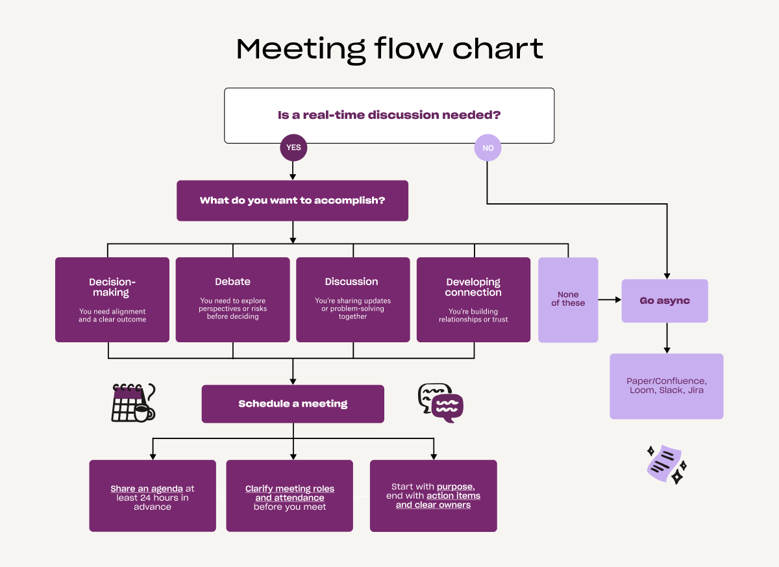
3. When we plan gatherings with purpose, teams don’t just feel more connected. They get more done.
Intentional in-person meetings lead to more lasting results.
At Dropbox, offsites continue to be one of the best ways to build teamwork and strengthen our sense of belonging. Feedback also consistently shows that team and cross-functional gatherings build trust and speed up delivery. Recent feedback reminds us that even what’s working well benefits from continued attention and iteration.
What we learned:
Employees want offsites with a clear purpose, shared goals, and designs that reflect their team’s needs. The best gatherings have well-defined goals, involve everyone in the experience, and are closely connected to what a team needs at that moment. Employees prefer less time spent on passive presentations and more time collaborating in smaller groups. They also want offsites that build connections and a team culture that lasts long after the event itself.
The impact of a well-designed offsite is significant. When our technical teams come together in person for shorter bursts, typically focused on specific goals or solutions, we’ve seen measurable improvements in both how teams work and what they deliver when they return to a virtual environment.
For example, across anchor weeks (a gathering type that allows larger working groups to execute on specific goals, urgent deliverables, and overlapping projects—like bug bashes before a product launch) and other offsites in 2025, we saw:
- Nearly all employees reported stronger relationships (94%), real progress on projects (83%), greater trust (71%), and clearer communication (70%).
- Engineers finished 10% more work overall, completed tasks faster, and resolved three times as many code issues as usual.
- Teams also finished major projects six weeks early, and in another group, system issues dropped by more than 70%.
How we’re moving forward:
As we listened to employees and reflected on what made recent gatherings so impactful, we saw that intent consistently mattered more than format. The gatherings that delivered the strongest results were grounded in clear goals shaped around immediate needs. This learning pushed us to rethink how we approach gatherings altogether, moving beyond predefined categories like offsites or retreats, and toward a more flexible, purpose-led framework that helps teams make the most of their time together.
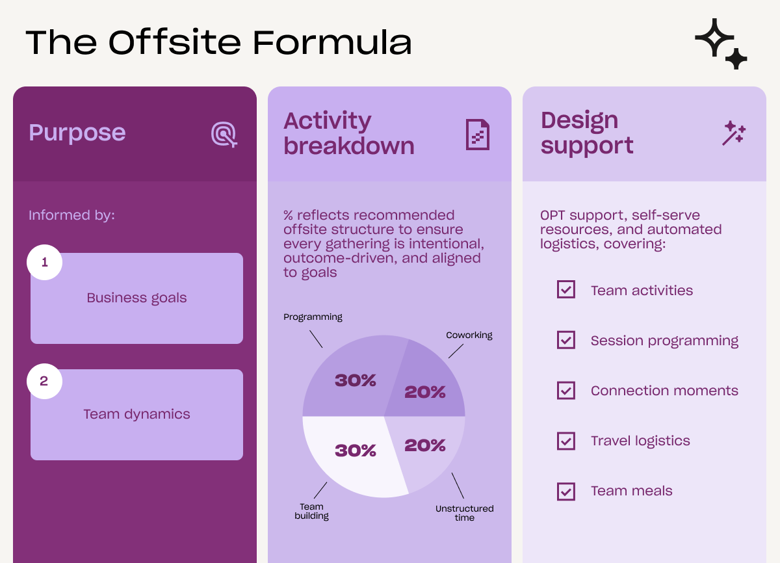
Enter the new Offsite Formula: a flexible framework designed to help teams consistently plan purposeful gatherings. It follows a base structure, including 30% programming, 30% team building, 20% coworking, and 20% unstructured free time. This mix emerged from employee feedback showing that every type of offsite needed more balance than our traditional, modality-based designs allowed. At the same time, the structure remains flexible; any of these elements can be dialed up or down based on the desired outcome. This ensures every offsite supports both business and relationship-building goals, and also factors in unique team dynamics.
We’ll also infuse specific connection moments into the new framework. These are lightweight, meaningful activities that can easily fit into any offsite agenda, like team games, a unique group dinner toast, or storytelling prompts that help make offsites more personal. These moments extend beyond offsites, giving teams easy ways to connect before, during, and after gatherings, helping relationships last well beyond the event.
Finally, employees asked for more support in choosing the right content and activities for their offsites. In response, we’re now expanding the role of our Offsite Planning Team beyond logistics to help teams create organized, goal-focused experiences that lead to clear results. For teams that prefer a self-serve option, we’re launching an AI-powered Offsite Design GPT. Guided by prompts and powered by playbooks and resources, this interactive tool extends the reach of our Offsite Planning Team, making thoughtful offsite planning more accessible than ever.
Your team, your impact
We've revolutionized cloud storage. Now, we're pioneering the future of AI-enhanced work. See how your potential can unlock something bigger at Dropbox.


